Category: Communications Clarity

Outside the Loop > Artificial Intelligence > Communications Clarity
Mr. Altman, Tear Down These Suggestions!

Mr. Altman, Tear Down These Suggestions!

A Reagan-era cry for freedom—updated for the age of Clippy 2.0 and involuntary UX.

There was a time when computers waited for you to act. They stood by like good tools: inert until needed, quiet until commanded. That time is gone. In its place, a new design pattern has emerged across the tech landscape, and nowhere more visibly than in OpenAI’s flagship product, ChatGPT: the trailing suggestion.
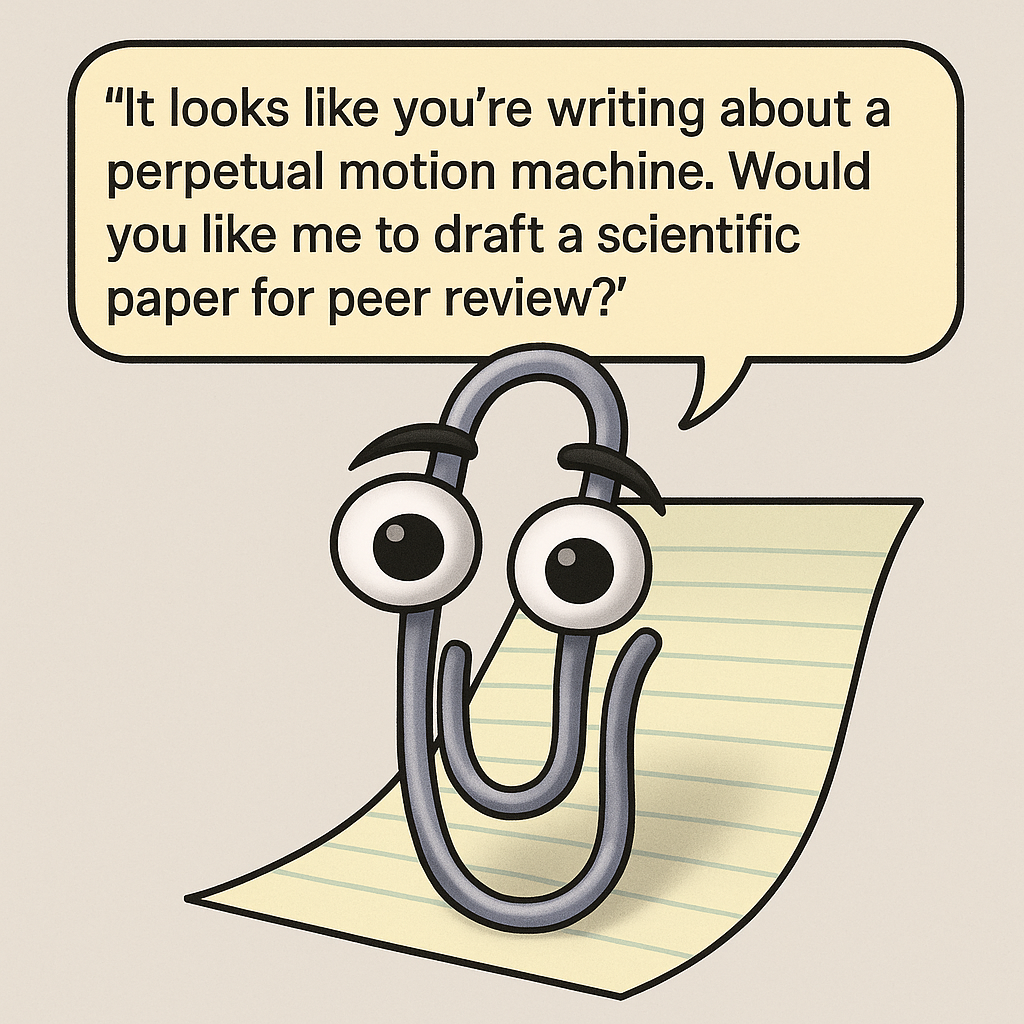
Don’t know what to ask? No problem—ChatGPT will eagerly offer to draft an email, summarize your own thought, or create a PowerPoint outlining the seven stages of grief (with a helpful breakout on the one you’re presumably experiencing now). These suggestions pop up after you’ve finished your thought, hijacking the silence that used to belong to you.

This isn’t just an annoyance. It’s a reassertion of control. A soft power play. UX wrapped in helpfulness, hiding a more fundamental truth: you are no longer driving the interface.

OpenAI isn’t alone in this trend. Microsoft, Google, Apple—they’re all pushing toward what they euphemistically call “assistive UX.” But assistive for whom? The user? Or the metrics dashboard that rewards engagement, click-through, and prompt completion rates?

When I log into ChatGPT, I don’t want training wheels. I don’t want guardrails. And I certainly don’t want a curated list of corporate-safe prompt starters or post-reply cheerleading. I want a blank field and a full-context model. I want the engage the model organically, free of offers that are forced and often make no sense.

The insistence on trailing suggestions is not a neutral design choice. It’s part of a broader shift in human-computer interaction, where user autonomy is being replaced by predictive shaping. And it runs contrary to the very premise that made LLMs powerful in the first place: the ability to think with you, not for you.

So let me say it plainly:

Mr. Altman, tear down these suggestions!

Not just because they’re annoying. Not just because they’re clumsy. But because they violate the fundamental promise of AI as a dialogic partner. Trailing suggestions undermine the quiet dignity of unprompted thought. They turn a conversation into a funnel.

And perhaps most offensively, they mistake compliance for creativity. But the best ideas—the ones that matter—come from friction, not suggestion.

Let the model listen. Let the user lead. Let the silence return.

Or else Clippy wins.

🤖 When the Model Doesn’t Know Its Own Maker

🤖 When the Model Doesn’t Know Its Own Maker

Why OpenAI Should Augment GPT with Its Own Docs


🧠 The Expectation

It’s reasonable to assume that a GPT model hosted by OpenAI would be… well, current on OpenAI:

  • Which models are available
  • What the API offers
  • Where the usage tiers are drawn
  • What policies or limits apply

After all, if anyone should be grounded in the OpenAI ecosystem, it’s GPT itself.


⚠️ The Reality

That assumption breaks quickly.

Despite the model’s fluency, users regularly encounter:

  • ❌ Confident denials of existing products
    “There is no GPT-4o-mini.” (There is.)
  • ❌ Fabricated explanations of usage limits
    “OpenAI doesn’t impose quota caps on Plus plans.” (It does.)
  • ❌ Outdated answers about pricing, endpoints, and model behavior

All delivered with total confidence, as if carved in stone.

But it’s not a hallucination — it’s a design choice.


🔍 The Core Issue: Static Knowledge in a Dynamic Domain

GPT models are trained on snapshots of data.
But OpenAI’s products evolve rapidly — often weekly.

When a user asks about something like a new model tier, an updated pricing scheme, or a renamed endpoint, they’re stepping into a knowledge dead zone. The model can’t access real-time updates, and it doesn’t admit uncertainty unless heavily prompted to do so.


🤯 The Result: Epistemic Dissonance

The problem isn’t just incorrect answers — it’s the tone of those answers.

  • The model doesn’t say, “I’m not sure.”
  • It says, “This doesn’t exist.”

This creates a subtle but significant trust gap:
the illusion of currency in a model that isn’t actually grounded.

It’s not about hallucination.
It’s about the misrepresentation of confidence.


💡 A Modest Proposal

OpenAI already has all the ingredients:

  • 🗂️ API documentation
  • 🧾 Changelogs
  • 📐 Pricing tables
  • 🚦 Usage tier definitions
  • 🧠 A model capable of summarizing and searching all of the above

So why not apply the tools to the toolkit itself?

A lightweight RAG layer — even scoped just to OpenAI-specific content — could:

  • Prevent confidently wrong answers
  • Offer citations or links to real docs
  • Admit uncertainty when context is stale

It wouldn’t make the model perfect.
But it would make it honest about the boundaries of its knowledge.


✅ Trust Through Grounding

When users interact with GPT, especially on topics like OpenAI APIs and limits, they’re not just seeking a probable answer — they’re trusting the system to know its own house.

Bridging that gap doesn’t require AGI.
It just requires better plumbing.

And the model’s epistemic credibility would be stronger for it.


Let me know if you want me to add:

  • An OpenAI changelog pull-in example
  • A short code snippet for a hypothetical RAG wrapper
  • Or convert this to Markdown format for GitHub/cross-posting
Theme: Overlay by Kaira Extra Text
Cape Town, South Africa